Blog

  • Data Center Investments or Nuclear Energy Investments in the Market?

    While reviewing the AI-generated reports I use to track market trends today, one statistic immediately stood out.

    Among the investment themes I monitor, memory semiconductor stocks have delivered an impressive +174% return, while the nuclear energy theme has declined by roughly 11% over the same period.

    What makes this comparison fascinating is that both belong to the same broader narrative: the artificial intelligence revolution. They operate in the same stock market, under the same macroeconomic environment, and are both expected to benefit from AI-driven capital spending. Yet their market performance has been dramatically different.

    The explanation lies in how capital flows through investment cycles. The first beneficiaries of the AI boom have been companies directly tied to computing infrastructure—particularly those producing high-bandwidth memory (HBM), advanced DRAM, GPUs, networking equipment, and data center hardware. Global spending on AI infrastructure is accelerating rapidly. According to industry forecasts, worldwide data center investment is expected to exceed $1 trillion annually by the end of the decade, driven largely by hyperscale cloud providers expanding AI capacity. Meanwhile, electricity demand from data centers is projected to more than double by 2030, making energy one of the next major investment stories.

    Nuclear energy undoubtedly has a compelling long-term outlook. Governments and technology companies increasingly view nuclear power—especially small modular reactors (SMRs)—as a potential solution for supplying reliable, carbon-free electricity to AI data centers. However, the investment timeline is fundamentally different. Building nuclear capacity typically requires years of regulatory approvals, financing, engineering, and construction before meaningful revenue can be generated. Markets often reward companies generating cash flows today more aggressively than those whose opportunities may materialize several years from now.

    This illustrates one of the most important lessons in investing: being right about the long-term trend is not enough—you also need to be positioned in the part of the value chain where capital is flowing today.

    The difference between owning the strongest AI sub-theme and the weakest one can mean the difference between doubling a portfolio in a year or watching it significantly underperform.

    That is why I spend less time asking, “Where is the market heading?” and much more time asking, “Which investment theme is attracting capital right now?” In modern markets, identifying the right theme often matters even more than predicting the overall direction of the market.
  • The Data Center Story Isn’t Just About Chips

    The AI infrastructure boom extends far beyond semiconductor companies. One of the latest examples came from the power infrastructure sector.

    Bloom Energy (NYSE: BE) surged more than 10% after announcing a strategic agreement with Brookfield Asset Management to support the growing electricity needs of AI-driven data centers. The partnership is valued at up to $25 billion and aims to deploy Bloom’s solid oxide fuel cell technology to provide reliable on-site power for hyperscale AI facilities.

    The timing is no coincidence. According to the International Energy Agency, global electricity demand from data centers is expected to more than double by 2030, with AI becoming the primary driver of that growth. Meanwhile, leading technology companies are planning to invest hundreds of billions of dollars in AI infrastructure over the coming years, creating enormous demand not only for GPUs but also for power generation, grid equipment, cooling systems, and backup energy solutions.

    The takeaway is simple: the data center investment story isn’t just about chips. Every layer of the ecosystem—from semiconductors and networking equipment to power generation, cooling, and electrical infrastructure—is positioned to benefit from the AI expansion.

  • Why Did Micron Stock Go Down? -81,23 (-6,69%) – Friday, June 26

    On Friday, June 26, US stock markets experienced a broad pullback led by the semiconductor sector. One of the most heavily affected stocks was the AI memory technology giant, Micron Technology (MU). After a historic rally on Thursday, the stock slid 6.69% on Friday to close at $1,133.67.

    Here are the key catalysts behind Micron’s Friday decline despite its jaw-dropping financial results:

    1. Profit-Taking After a Massive Surge

    Micron released a blockbuster Q3 fiscal report after Wednesday’s closing bell, shattering Wall Street expectations.

    • Quarterly revenue surged 346% year-over-year to $41.46 billion (vs. expectations of $35.9 billion).

    • Adjusted Earnings Per Share (EPS) came in at $25.11, crushing the consensus estimate of $20.78.

    Following these stellar numbers, the stock skyrocketed 15.74% on Thursday. Naturally, Friday saw investors adopting a “sell the news” approach, locking in quick gains through healthy profit-taking.

    2. OpenAI IPO Delay Rumors and Sector-Wide Pressure

    The tech sector was rattled by rumors that OpenAI—the poster child of the AI boom—is considering postponing its highly anticipated Initial Public Offering (IPO) to 2027, following market volatility seen in recent mega-tech listings.

    The Domino Effect: Fears arose that a delayed capital injection into OpenAI could temporarily cool down the aggressive infrastructure spending of cloud giants, potentially slowing orders for high-bandwidth memory (HBM) chips supplied by Micron.

    This sentiment dragged down the entire sector, causing South Korean rivals SK Hynix to drop nearly 8% and Samsung to slide 5%.

    3. Macroeconomic Factors and Valuation Concerns

    Stronger-than-expected US labor data and persistent inflation signals kept the Federal Reserve’s hawkish tone alive, dampening hopes for imminent interest rate cuts. High-interest-rate environments generally pressure high-multiplier growth stocks. With Micron’s P/E ratio reaching 27.47x—well above its 5-year median of 20.66x—some market participants perceived the stock as overvalued in the short term, triggering technical sell-offs.

    In Summary; Micron’s Friday drop was not driven by any operational weakness within the company. Instead, it was a classic case of profit-taking, AI sector-specific rumors, and a broader macroeconomic correction following a massive rally. Given Micron’s robust Q4 revenue guidance (~$50 billion) and over $100 billion in long-term contracts, the company’s underlying fundamentals remain incredibly strong.

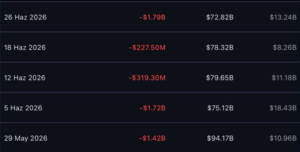
  • Bitcoin ETF Outflows Hit $1.79 Billion in Seven Weeks

    Bitcoin ETF Outflows Hit $1.79 Billion in Seven Weeks as BlackRock Records $445 Million Daily Withdrawal

    Bitcoin spot ETFs continued to face selling pressure, with $445 million in net outflows recorded in a single trading session, according to the latest fund flow data. Notably, the entire daily outflow came from BlackRock’s iShares Bitcoin Trust (IBIT), while all other U.S. spot Bitcoin ETFs reported flat flows with no significant inflows or outflows.

    On a weekly basis, cumulative net outflows climbed to $1.79 billion, marking the largest seven-week withdrawal streak seen in recent months. The continued selling trend suggests institutional demand for spot Bitcoin ETFs remains subdued despite Bitcoin trading near historically elevated price levels.

    Market analysts note that ETF flows are closely watched as a gauge of institutional investor sentiment. Persistent net outflows may indicate profit-taking, portfolio rebalancing, or reduced risk appetite among large investors. While ETF demand has softened in recent weeks, long-term market participants continue to monitor whether renewed institutional inflows could provide fresh momentum for Bitcoin’s next major move.

    The ongoing lack of demand from spot Bitcoin ETFs remains one of the key factors influencing short-term cryptocurrency market sentiment.

  • Did the Stock Market Drop Because Iran Violated the Ceasefire?

    Did Iran’s Ceasefire Violation Trigger the Latest U.S. Stock Market Decline?

    U.S. stock markets closed slightly lower after President Donald Trump stated that Iran had violated the recently announced ceasefire, raising fresh concerns about geopolitical stability in the Middle East.

    The renewed uncertainty weighed on investor sentiment, particularly as markets had been hoping for a sustained de-escalation in regional tensions. While the declines were modest, traders shifted toward a more cautious stance as geopolitical risks returned to the spotlight.

    The Nasdaq Composite fell 0.2% to close at 25,297.6, marking its fifth consecutive losing session. Meanwhile, the S&P 500 slipped 0.1% to 7,354, and the Dow Jones Industrial Average also declined 0.1%, ending the day at 51,876.1.

    Although Trump’s comments appeared to be a catalyst for the market’s cautious tone, analysts noted that investors were also digesting recent gains in U.S. equities and awaiting upcoming economic data and corporate earnings reports. As a result, the market reaction reflected a combination of geopolitical uncertainty and profit-taking rather than panic selling.

    Looking ahead, investors will continue to monitor developments surrounding the Iran-Israel ceasefire, as well as any potential impact on global energy markets and crude oil prices. Further escalation could increase market volatility, while signs of diplomatic progress may help restore investor confidence.

    Investor Takeaway: What to Watch Next

    The immediate reaction to the ceasefire violation news proves that geopolitical headlines remain a primary driver of short-term volatility on Wall Street. For the upcoming sessions, investors will be closely monitoring:

    1. Official Statements: Direct diplomatic or military confirmations regarding the status of the Middle East ceasefire.

    2. Oil Prices: Any sudden spike in Brent or WTI crude that could reignite broader inflationary fears.

    3. The Nasdaq Support Level: Whether buyers will step in to break the tech index’s five-day losing streak or if the correction will deepen.

  • US Stocks End Mixed as Big Tech Weakness Offsets Strong Micron Earnings

    US Stocks End Mixed as Big Tech Weakness Offsets Strong Micron Earnings

    22 – 27 June 2026

    U.S. stock markets closed the week on a mixed note as investors balanced encouraging corporate earnings against renewed weakness in large-cap technology stocks.

    Despite Micron Technology delivering stronger-than-expected quarterly results and issuing an optimistic outlook driven by continued demand for AI-related memory products, selling pressure across several mega-cap technology companies weighed on overall market performance. The weakness among the “Magnificent Seven” limited gains in the broader market and kept both the Nasdaq Composite and the S&P 500 under pressure.

    Meanwhile, market sentiment improved after reports indicated that commercial shipping activity through the Strait of Hormuz had partially returned to normal. The easing of immediate concerns over one of the world’s most critical energy shipping routes helped reduce fears of potential disruptions to global oil supplies and contributed to a more stable risk environment.

    Investors continued to monitor geopolitical developments alongside expectations for future Federal Reserve policy. While optimism surrounding artificial intelligence, corporate earnings, and resilient economic data remained supportive, profit-taking in high-growth technology stocks highlighted investors’ cautious approach following the sector’s strong rally in recent months.

    Key Takeaways

    • U.S. equity markets finished the week with mixed performance.
    • Weakness in several mega-cap technology stocks offset strong earnings from Micron Technology.
    • The Magnificent Seven continued to experience profit-taking after recent gains.
    • Improving shipping conditions in the Strait of Hormuz helped ease concerns about global energy supply disruptions.
    • Investors remain focused on upcoming economic data, corporate earnings, and potential Federal Reserve policy changes as they assess the market outlook for the coming weeks.


    What to Watch Next Week

    As Wall Street navigates this mixed sentiment, the focus strictly shifts to macro data. Investors will closely monitor Federal Reserve commentary and upcoming inflation metrics to gauge whether the tech sector’s correction will deepen or if the broader market’s rotation into value stocks will sustain the next leg of the bull market.